TL;DR: This comprehensive comparison of AI app builders Lovable, Replit, and Bubble reveals that while Lovable excels at design-focused prototypes using React and Supabase, and Replit serves developers who want a cloud-based IDE, Bubble stands out as the only platform combining AI speed with visual programming for building production-ready, scalable apps without requiring coding expertise. The key differentiator is how each platform helps you get ready to deploy and scale — Bubble's visual editor provides full control for non-technical users, while Lovable and Replit rely heavily on AI prompting or manual coding.
Overwhelmed by AI tools for building apps and software? Not all AI app builders are created equal — and with new ones launching constantly, choosing the right one is challenging.
We tested three of the most talked-about tools available right now — Lovable, Replit, and Bubble — to sort out the pros and cons for ourselves — and for you. In this comparison, we'll cover everything from initial output quality to customization, security, and what happens when AI hits its limits. Whether you're an aspiring entrepreneur, an in-house problem solver, or a developer looking to move faster, this guide will help you find the right platform for your goals.
What is an AI app builder?
An AI app builder is a tool that lets you describe an application idea in plain language, and then uses artificial intelligence to generate the app for you — including the user interface, database, and even the underlying logic. They range from simple prototype tools to platforms for building production-grade applications that scale.
In this article, we compare all three platforms — the benefits, the drawbacks, and the best use cases for each — but if you’re curious to see a deep dive into each, check out our other comparisons:
Lovable vs. Replit vs. Bubble: Key factors
Regardless of platform features, there is one major factor to keep in mind when choosing an AI builder: what happens after you generate.
As we compare these platforms, consider both initial output quality and how each handles the final refinements. This includes:
- Iterations and customization control
- Scaling capabilities
- Security features
- Long-term costs
This is especially true if you don’t have coding expertise. When AI reaches its limits, developers can edit code directly, but non-coders often find themselves in "prompt loops" — endlessly prompting without getting desired results.
Each of these platforms resolves the last 20% problem differently:
- Bubble: Combines AI chat for quick generation with full-stack visual editing for precise control — no code required.
- Replit: Focuses on giving developers full access to their code in a familiar code-editing environment, which makes it easier to optimize your code (for those with the experience).
- Lovable: Takes a middle-of-the-road approach, combining options to use AI chat, direct code editing (on paid plans), or a limited visual editor for certain UI elements.
Here’s how the three platforms stack up against other key factors we considered:
| Factor | Lovable | Replit | Bubble |
|---|---|---|---|
| Initial generation quality | ⭐⭐⭐⭐ | ⭐⭐⭐💫 | ⭐⭐⭐⭐ |
| Design capabilities | ⭐⭐⭐💫 Responsive design and AI-powered iterative editing, but limited visual editing capabilities. |
⭐⭐ Responsive design but no visual editor. |
⭐⭐⭐⭐ Responsive design with AI-powered generation and editing via the Bubble AI Agent, plus drag-and-drop visual editor for pixel-perfect control. |
| Native mobile app support | ⭐ None. Lovable focuses exclusively on web application development and requires a wrapper to approximate the native experience. | ⭐⭐⭐⭐ Generate React Native mobile apps with AI and deploy via Expo. (Code editing required for complex logic.) |
⭐⭐⭐⭐ Build truly native mobile apps with AI and deploy to the Apple App Store and Google Play. Share backend and data with your web app. |
| Collaboration | ⭐⭐⭐ Workspace collaboration for up to 20 members on Free and Pro plans, with project-level invitations via email. |
⭐⭐⭐⭐⭐ Full IDE with GitHub integration. Teams plan ($35/user/mo) offers role-based access control (RBAC) and private deployments. |
⭐⭐⭐⭐⭐ Real-time collaboration with adjustable permissions for each user, depending on your plan. |
| Backend and database support | ⭐⭐⭐⭐ Built-in backend via Lovable Cloud (utilizing Supabase's open-source foundation), with optional external Supabase integration. |
⭐⭐⭐ Built-in Replit Database (Postgres) and object storage, but setup can be confusing for nontechnical users. |
⭐⭐⭐⭐⭐ Native backend and database that doesn’t require technical expertise or extra costs to set up. |
| Security and compliance | ⭐⭐⭐⭐ Enterprise-grade security with SOC 2 Type 2, SOC 2 Type 1, and ISO 27001:2022 certifications. Builders are responsible for implementing app-level privacy rules. |
⭐⭐⭐ Strong platform-level security (SOC 2 compliant) backed by Google Cloud, but app-specific security is up to the developer and has to be coded manually. |
⭐⭐⭐⭐ Enterprise-grade security features, including SOC-II and GDPR compliance, advanced encryption and monitoring, and custom privacy rules. |
| Deployment/hosting | ⭐⭐⭐⭐ One-click deployment with built-in hosting via Lovable Cloud, or optional export to third-party hosting like Netlify or Vercel. |
⭐⭐⭐⭐⭐ One-click deployment with Autoscale or Reserved VM options. |
⭐⭐⭐⭐⭐ One-click deployment and native hosting. |
| Technical expertise | ⭐⭐⭐⭐ Less technical than many AI builders, but technical background is still very helpful for iteration and launch. |
⭐⭐⭐ For moderately technical users (technical background helpful for going beyond the basics). |
⭐⭐⭐⭐⭐ Best-in-class for developers and non-developers alike. |
App output quality
The initial quality of your app output is a major factor when choosing between builders. The better the initial quality, the less work you'll have to do manually to get your app ready for launch.
The good news: Lovable, Replit, and Bubble all generate solid initial apps, but they each focus on different areas of output, making them ideal for different types of projects. We found Lovable best for design-focused projects, Bubble the strongest in creating working features and functionality ready for real-world use, and Replit somewhat in the middle across the board.
Lovable is a very design-focused platform. The initial output included really high-quality UI with visually pleasing apps. Of these three platforms, Lovable had the best AI-generated aesthetics, with polished layouts and clean branding and design from minimal prompting. It generates standard code — specifically React, Supabase, and Tailwind CSS — which is great if you plan to export your code later.
However, Lovable struggled with features and production-ready functionality. While the app looked amazing, it didn't always function as expected. In our research, we found that while the AI is great for front-end work, it can get stuck in "loops" when trying to fix complex backend logic, sometimes fixing one bug only to create another.
Lovable now has a built-in backend called Lovable Cloud (which utilizes Supabase's open-source foundation), though it also supports external Supabase integration for users who prefer that option. As a result, we liked Lovable best for creating landing pages, MVPs, and mockups — projects where you need strong design but functionality is less essential.
Bubble is strong across the board, and got solid UI scores from our testers, but what really stands out is that it generates everything you need for a fully-functional app: design, data, and logic. Not completely on the first try — but it does get you started in every area. Bubble's AI generates frontend UI and UX, backend databases with placeholder data, and functional workflows that connect features.
The Bubble AI Agent continues to assist as you build — generating and editing elements, workflows, and logic — while you can also switch to the visual editor anytime for precise control over every single aspect of your app.
Bubble is best for creating production-grade apps, especially for users who aren't confident coding. You're never stuck with code you can't read.
Replit takes a more “jack of all trades” approach. Like Bubble, it generates frontend, backend, and databases for your app, but its output across all three areas was less consistent. It’s not a design-focused app, so its UI was much more bare-bones compared to Lovable and Bubble. On features and functionality, it outperformed Lovable (in some cases), but struggled to create features that really “worked” from the initial output as Bubble’s did (i.e., buttons that really worked, search functionality, etc.)
A strength of Replit, for more experienced developers, is that it is code-forward. The Replit Agent (currently in versions v2 and v3) is designed to be autonomous, capable of planning, building, and even self-debugging in a real browser environment. This makes Replit a great option for speeding up existing workflows and avoiding having to start from scratch if you know how to code.
App development workflow
For this factor, we evaluated the actual process of generating an app with each platform, looking at how simple, intuitive, and effective it was.
What we found: Lovable and Replit have very similar workflows. They both use the basic process of prompting the AI and then bringing you to a split-screen view with the AI chat on the left-hand side, and the code / preview of your app on the right.
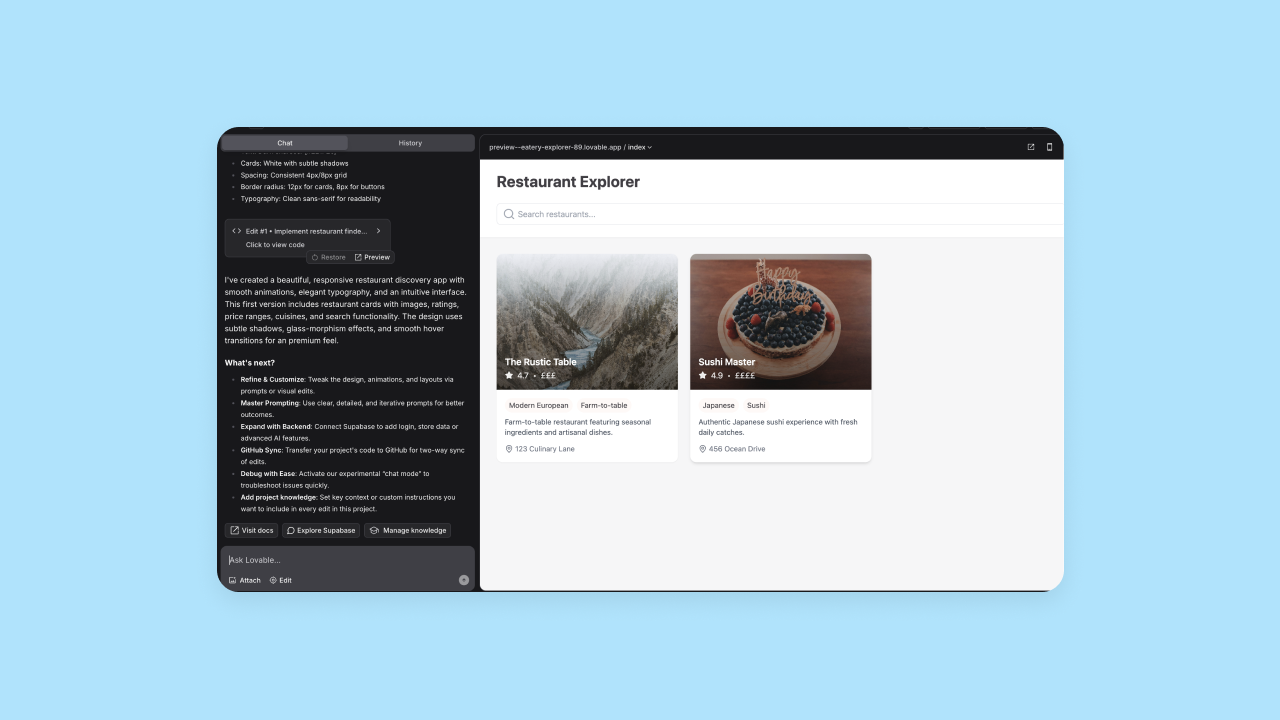
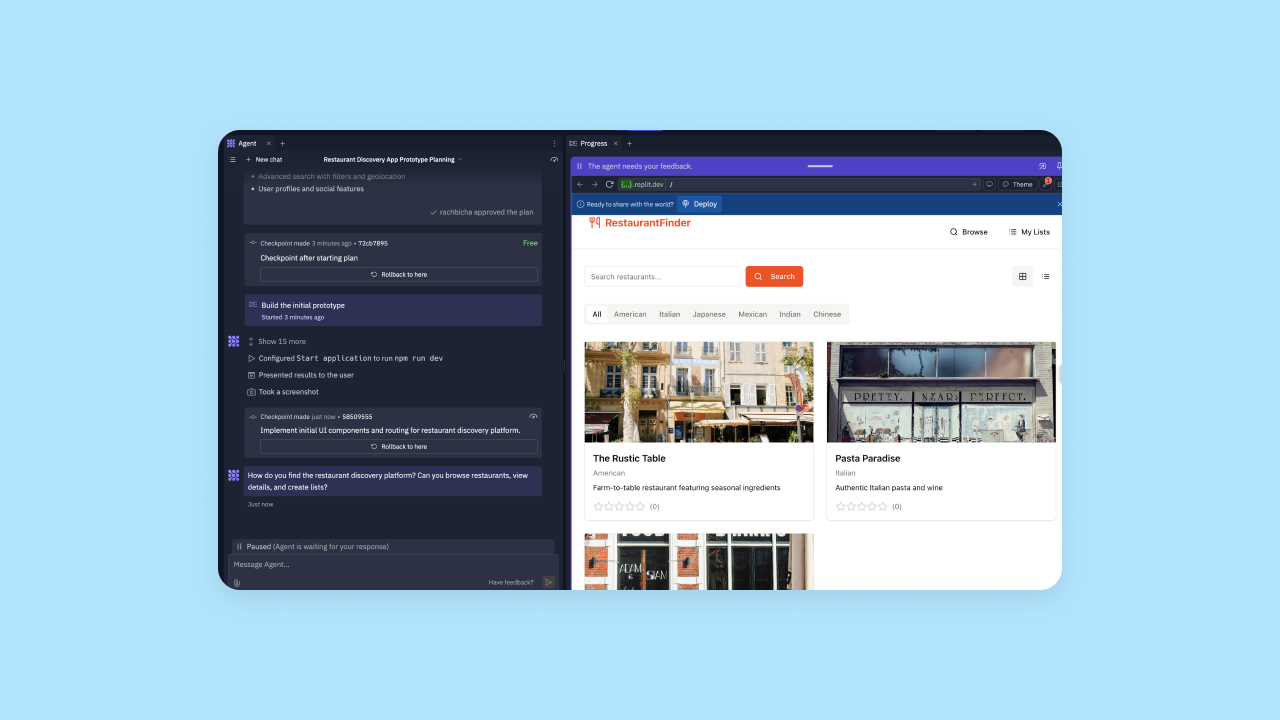
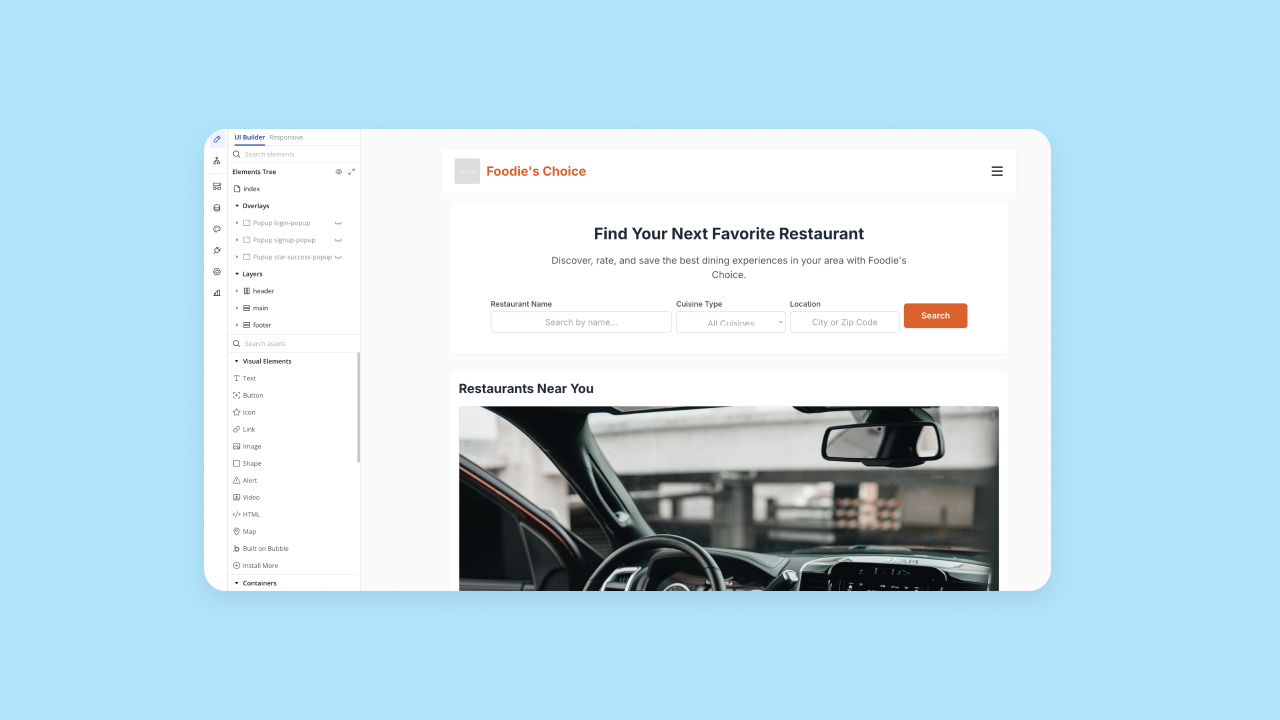
Bubble starts by generating a project plan and main features for you to approve, then builds your app in the background before opening it in the visual editor. The Agent remains available throughout development — you can continue to generate and edit elements, workflows, and logic through chat, or switch to the visual editor for precise control. Bubble's visual editor means you don't need a split-screen view — you preview your app and edit it all in the same place. As a result, Bubble's development workflow will probably feel more familiar to non-coders, and for folks who are used to working in visual, drag-and-drop editors like WordPress or Squarespace.
Here's how their development workflows compare:
| Feature | Lovable | Replit | Bubble |
|---|---|---|---|
| Generates a project plan to review first | ❌ | ✅ (via "Plan Mode") | ✅ |
| Provides a visual preview of your app | ✅ | ✅ | ✅ |
| Provides the code for your app | ✅ | ✅ | ❌ |
| Allows you to edit your app visually | ⚠️ Limited to multi-select elements, layout controls, margin/padding adjustments, text/color/font editing, image replacement, and AI image generation. |
❌ | ✅ |
| Allows you to edit the code of your app directly | ✅ via "Code Mode" (paid plans only) or via GitHub export. | ✅ | ⚠️ Custom code is optional, never required |
The best workflow depends on your technical experience and project type.
Lovable shines for non-developers who need limited customization and want to iterate on the app’s functionality via AI chat. Although AI iterations can be buggy and inconsistent, it’s a good option for developing mockups where functionality isn’t as much of a concern, or for creating simple personal apps. It operates in two main modes: "Chat mode" for planning and "Agent mode" for autonomous coding.
Replit is better for developers who are looking for seamless AI integration to a familiar code-based development environment. Replit gives you the ability to edit code directly in the platform while also using AI-driven iterations. It offers a "Plan mode" to brainstorm architecture before switching to "Build mode" where the Agent edits the project. However, it doesn't offer any visual development options, so it’s a steeper learning curve for beginners.
Bubble's visual editor eliminates the need for manual coding while being sophisticated enough to develop production-grade apps ready for launch and scale. You can chat with the Agent to generate and iterate on features, or edit directly in the visual editor — switching between them whenever you want. Custom code is also an option for experienced developers.
Which AI builder is right for you?
Lovable and Replit both provide AI-powered app generation in an editor that splits between a visual preview and an AI chat for ongoing iterations. Both offer the ability to use AI or traditional code for ongoing changes and a simple deployment process — but their best use cases and audiences are completely different.
Lovable offers an intuitive, easy-to-use builder for people who want to quickly spin up an MVP or a semi-functional prototype. Although developing more complex functionality can require more technical expertise, creating something simple is quick and the platform offers intuitive UX with decent AI-powered iterations for non-coders.
By contrast, Replit offers a programming environment with an integrated AI assistant, giving developers and others who are interested in learning and using traditional coding languages an all-in-one environment to generate code, iterate on it manually or via AI, and launch an app. It provides speed, AI assistance, and complete control via traditional code, plus stronger functional and backend support compared to Lovable.
Bubble takes a different approach: Combining the speed of AI with the power of visual programming, Bubble is the only AI-powered app development platform designed for real businesses built by everyday people. Where Lovable offers ease and speed, but without control, and Replit offers speed and control, but lacks technical ease, Bubble brings all three together. You get the ability to create production-grade apps and enterprise software tools with speed, scalability, and full customization, regardless of your level of technical expertise.
Plus, while Lovable and Replit both default to traditional code when you hit a wall with AI, Bubble uses a true visual approach that can take you all the way through launch and beyond. Many AI builders make building an MVP fast, but Bubble makes building a business fast.
Read on for a deeper dive into specific features and capabilities across all three platforms.
Customizability
Perhaps most importantly for those looking to build and scale businesses is the ability to customize your app. Lovable, Replit, and Bubble all take different approaches to the question of customization:
- Replit offers a high level of customization via manual coding, limited AI-based iterations, and no visual customization option.
- Lovable offers three customization options: AI-based iterations, manual code editing (via "Code Mode" on paid plans or via GitHub), and limited visual editing that includes multi-select elements, layout controls, margin/padding adjustments, text/color/font editing, image replacement, and AI image generation.
- Bubble goes all-in on drag-and-drop visual editing, with a high level of customization available (comparable to Replit’s level of customization, but with a visual editor instead of manual coding).
In short, these platforms offer three possible avenues for further customization of your app: manual coding, AI-based customizations, or visual customization.
Manual coding
Replit is the front-runner if you’re looking to customize your app manually with traditional code. Replit exposes the code the AI agent is writing within the development environment, so you can edit the code directly and make your app look and function exactly as you want it to.
Lovable also offers an in-platform code editor called "Code Mode," but it is only available on paid plans (Pro and above). Otherwise, you can export the code to GitHub and edit it there. Bubble allows anyone to add custom code for any element or feature, but works with a visual programming language that doesn’t require custom coding.
AI-generated customizations
AI-generated customizations via the AI chat is the primary way to make customizations in Lovable, which ends up being a mixed bag. It’s simple, even for non-coders — just prompt the chat with what changes you’d like to see and the AI will spin up the new output.
However, in practice, these customizations are unpredictable at best. Sometimes Lovable’s AI gave us exactly what we were looking for, while other times we got stuck in prompt loops, going back and forth with the AI chat without being able to get our app to look or function exactly how we wanted it to.
Replit also allows you to make customizations via the AI chat, but it struggles with the same issues. In general, our testers found they often got stuck, with the AI refusing to fix issues or breaking other elements in the process.
Visual customizations
Lovable offers limited visual editing that includes multi-select elements, layout controls, margin/padding adjustments, text/color/font editing, image replacement, and AI image generation. Many elements and changes — including changes to features — can't be done visually, only via the AI chat (or with custom code).
Bubble offers the strongest option for truly visual customizations. Unlike Lovable, Bubble gives you full control over UI design, workflows, actions, database structure, logic and functionality, and more. You can use the Agent to generate or modify these elements through chat, or edit them directly in the visual editor — switching between AI and visual editing whenever you need. This way, you get limitless customizability with the flexibility to work at the level of your technical knowledge.
Plus, you can debug and iterate on your app visually or ask the Agent to troubleshoot issues, identify problems, and explain how your app works. Whereas Lovable focuses on AI-prompted debugging (which is inconsistent at best), and Replit prioritizes traditional debugging in code, Bubble offers multiple ways to debug: the Agent can troubleshoot your app and identify issues, the issue checker automatically finds potential errors like missing data or incomplete actions, and you can fix everything through the visual editor — no code required.
Design functionality
Design functionality of a platform impacts how easy it will be to create a visually beautiful app.
The biggest differences to consider are how design-oriented a platform is and how easy the platform makes it to design your app. Those seem similar, but Lovable and Replit’s approaches to design functionality illustrate the differences: Lovable is a very design-forward platform, but with limited design functionality. Replit isn’t a design-focused platform, but it offers more design functionality through manual coding. Neither Lovable nor Replit offers a strong visual editor for design work, but Bubble does.
Lovable generates strong AI-powered designs with responsive layouts automatically using Tailwind CSS, but lacks robust visual design tools — you can make design changes visually including multi-select elements, layout controls, margin/padding adjustments, text/color/font editing, and image replacement. All other design changes have to be changed manually (via code) or iteratively via the AI chat.
Replit has minimal design-specific functionality — it's primarily an AI-enabled coding environment without visual design tools. Plus, the initial output from our testing was often pretty basic in design compared to Lovable’s output. Replit’s platform also doesn’t use a beginner-friendly, intuitive UX for designing like Lovable and Bubble do. However, you can, of course, make any design choices you like via manual coding.
Bubble takes a very visual approach to design and offers strong design functionality, including a drag-and-drop visual editor that allows you to design down to the pixel without using traditional code. You get complete customization and control over your design (which can be tricky in Lovable or Replit) within the visual editor.
Even better: Bubble gives you the ability to create a design system, creating reusable UI components and styles that can be applied to multiple elements or across your whole app.
Replit doesn't offer much design-specific functionality.
Collaboration
As you build and grow your app and business, you absolutely want to consider how easy it is to collaborate on your platform of choice.
The most important factors to consider here will vary based on your needs, but in general, you want to consider if the platform supports multi-user projects, team plans / collaborators, real-time collaboration, and user-specific access permissions.
Here’s how these three stack up on collaboration:
| Feature | Lovable | Replit | Bubble |
|---|---|---|---|
| Unlimited collaborators on each app | ✅ Up to 20 members on Free and Pro plans | ✅ | ✅ Depending on your plan |
| Choose which apps collaborators can access | ✅ | ✅ | ✅ |
| Set access permissions for each users | ❌ | ⚠️ Limited (view, edit, deploy, owner) | ✅ |
| Collaborate in real-time | ❌ | ✅ | ✅ |
| Team plans available | ❌ | ✅ | ✅ |
| Version control available | ❌ | ✅ | ✅ |
Lovable offers workspace collaboration with up to 20 members on Free and Pro plans, allowing users to invite collaborators to specific projects via email. However, it lacks advanced features like real-time collaboration, version control, and team plans that are important for larger projects.
However, Replit and Bubble both provide strong collaboration features, including real-time collaboration, access permissions, and team plans. There are two key areas where they differ:
- Bubble offers more robust access permissions, allowing you to grant users permissions to edit and view certain areas of your app (i.e. just the frontend, including the database and logs or not, etc.), while Replit only offers full edit access or view access only. In this way, Bubble gives builders slightly more control and security over their app development environment.
- Bubble and Replit manage team pricing differently. On Replit, team pricing is both seat-based and usage-based, with seats starting at $35 per user per month (billed annually), which includes $40/month in usage credits. Bubble’s team plans start at $119 per month (including hosting and a built-in database).
Security
Security is also obviously a key factor to consider if you’re looking to build and scale production-grade apps for end users (or even for internal enterprise use!). In general, your app will only be as secure as the platform you build it on, so it’s worth considering before you start building.
The key differences to consider are how each platform manages platform-level security (the security of the platform you’re building on) and app-level security (the security of the app you’re building for your data and end-user data). For users without a technical background, it’s also important to consider how much security is “built in” vs. what you’ll be expected to implement yourself.
These three platforms offer varying levels of security: Lovable provides enterprise-grade platform security with SOC 2 Type 2, SOC 2 Type 1, ISO 27001:2022 certifications, and GDPR compliance, though builders are responsible for implementing app-level privacy rules. Replit offers strong platform security but still leaves much of the responsibility on builders, and Bubble offers the strongest security overall with both platform and app-level features.
Lovable provides enterprise-grade platform security (see table above) but builders must implement app-level privacy rules.
Replit's platform security is strong, backed by Google Cloud infrastructure and SOC 2 compliance, but app-level security requires manual configuration and coding.
Bubble offers the strongest out-of-the-box security at both platform and app levels. The AI Agent automatically generates privacy rules when creating data types. You can also set up and customize privacy rules via the visual editor — no coding required. And Bubble provides guidance to help non-developers through the process to make it easier for anyone to build a secure app. Bubble's integrated security dashboard automatically scans for potential vulnerabilities in your app, including leaked API keys and unsafe configurations. It provides proactive alerts and guides you to fix issues directly in the editor. You don't have to be a cybersecurity expert — Bubble provides the support you need to build a secure app that's ready for enduser data and scaling a business.
Native mobile app creation
While responsive web apps capture mobile traffic, native mobile apps offer significantly more possibilities—especially when built on a unified platform.
Native mobile app creation is currently a big differentiator for AI app-building platforms: Lovable doesn’t support native mobile app development, while Replit and Bubble both support React Native mobile apps.
On Replit, you can add the Expo framework to your Replit environment, then prompt the AI as usual, and it will generate React Native code for mobile. You can preview the mobile app on your phone, and then make changes manually to the code or via the AI chat. Non-programmers may struggle to get advanced customizations and complex logic since they’re limited to iterations via the AI chat.
Bubble's native mobile app development is in public beta and available to all users. You can generate mobile apps with Bubble AI or build them from scratch using the visual editor. React Native mobile apps on Bubble are supported by the visual editor, giving programmers and non-programmers alike full control. You can build and edit native device features, mobile-friendly gestures and interactions, and other mobile-specific designs directly via the visual editor — no coding required.
Then, you can preview and test everything using BubbleGo, our app for mobile testing and publish your app to native mobile app stores directly from the Bubble editor.
Framework support
Frameworks provide pre-built bits of code that can do basic tasks for common components, like reusable UI components or pre-built workflows. Each framework is unique to a certain programming language — for example, Angular is the framework for TypeScript/JavaScript.
Considering framework support of a platform is more important for technical users that may be more familiar with certain programming languages, or otherwise need their app to run on certain languages for tech stack integration.
All three of these platforms take a different approach to framework support:
- Lovable only supports the React framework and offers a limited approach to visual programming.
- Replit supports a wide range of programming languages through its Nix integration, having evolved from supporting 50 specific languages to enabling support for virtually all programming languages.
- Bubble takes a different approach altogether and uses a visual programming language unique to the Bubble platform. It eliminates the need to integrate frameworks or learn a specific coding language by allowing you to build, test, iterate, debug, and scale your app visually.
For experienced developers, Replit offers the most programming language flexibility.
By contrast, Bubble offers flexibility through visual programming that requires no coding, while still supporting custom code for technical users.
Integrations
Plugins and integrations can create an ecosystem of support that can expand the possibilities and capabilities of the platform you’re using — and the app you create. The key factor to consider with integrations on any AI app-building platform is:
- How robust their integrations library is
- How easy the integrations are to use
- Who “owns” the maintenance and updates for integrations
Here’s how these three platforms stack up on each of these factors:
| Feature | Lovable | Replit | Bubble |
|---|---|---|---|
| Robust integration library | ❌ | ❌ | ✅ |
| Easy-to-use integrations | ❌ | ✅ | ✅ |
| Integrations maintained by an expert | ❌ | Varies | ✅ |
Lovable offers multiple integrations including Lovable Cloud (built-in backend), Supabase, GitHub, Stripe, Shopify, Lovable AI, ElevenLabs, Firecrawl, and Perplexity, among others. The platform supports both shared connectors and personal connectors (MCP servers). These integrations require more setup and context to use, which can be tricky for non-developers.
Replit offers built-in integrations accessible via the Replit editor, including Slack, HubSpot, Stripe, Google Sheets and Docs, OpenAI, Anthropic, and other services. Following their acquisition of OpenInt, Replit has expanded its "Connectors" to include over 20 external services like Salesforce and Jira. These integrations include both Replit-managed integrations (requiring no setup) and Connectors (first-party integrations that persist across apps). With a little more hands-on configuration, manually or via the AI editor, some users have been able to add other integrations as well.
Bubble offers the largest integration library by far, with thousands of expert-built plugins and integrations including:
- OpenAI and Chat-GPT 4
- Anthropic Claude AI
- DALL-E
- Github
- Figma
- Stripe
- Paypal
- Google Suite products
- and thousands more
Bubble’s plugins are built and maintained by expert developers, who know how to create custom functionality and maintain it. Plus, Bubble’s integrations “just work” with the platform and require very little setup. If there’s something else you need, you can create your own plugins — without coding! — using Bubble’s API connector, which allows you to connect your app on Bubble to basically any other external app or system. And for experienced developers, you can even code your own plugins from scratch, if you’d rather.
Deployment and hosting
A simple deployment and hosting process makes it easy to get your app live and scale it for end-users.
Lovable, Replit, and Bubble all take a similar approach to deployment, offering “one-click” deployment directly from the editor. Where they differ more is in hosting options.
Lovable offers built-in hosting through Lovable Cloud with automatic scaling. Users can also optionally export their code via GitHub integration to host on third-party platforms like Netlify or Vercel if preferred.
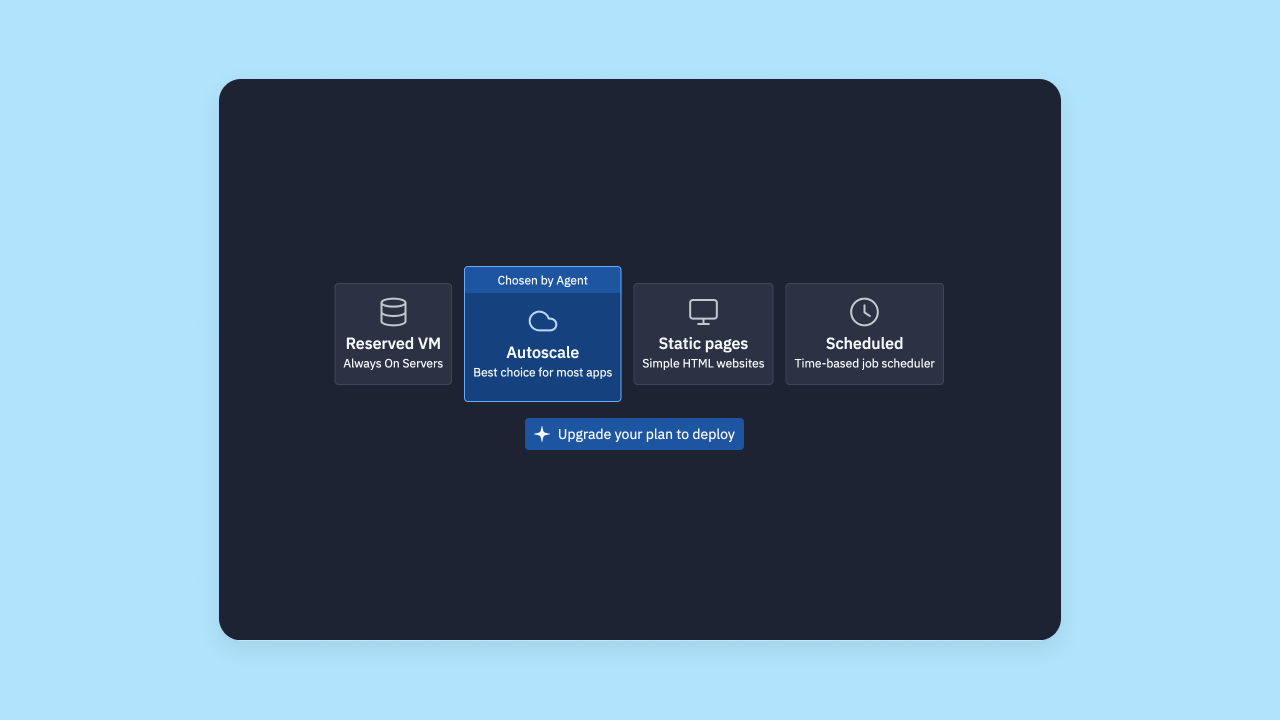
Replit offers built-in hosting, but many users have been frustrated with Replit’s hosting model. Publishing your app publicly automatically applies an MIT license to the code, making it open source. Private deployments are available on Teams ($35/user/month) and Enterprise tiers. Replit also provides multiple deployment options, including Autoscale Deployments and Reserved VMs, which may be a “pro” for developers who want a little more control, or a “con” for non-developers who want simplicity.
Bubble offers simple, built-in hosting via dedicated and enterprise-grade Bubble servers, which makes deployment and hosting a true “one-click” process. All-in-one hosting also makes updates and iterations faster, while giving you fewer platforms to juggle (and pay for!).
Education
This factor considers how many resources and how much educational support a platform provides for users.
Education is important to consider for experienced developers — as you’ll still need to find your way around a new platform and development environment — but it’s especially important for non-developers, who will want both platform-level, technical documentation and broader educational guides around building and developing apps.
Lovable and Replit both offer educational materials — primarily via their YouTube channels — with some basic technical documentation. However, their technical documentation manuals are pretty sparse.
In some ways, this makes sense for both of these platforms. Lovable has a very intuitive UX, so a lot of documentation doesn’t feel immediately necessary. Replit’s UX isn’t as intuitive, but they are also catering to more experienced developers, so it makes sense that they’d assume more background knowledge from their users. Replit does offer "100 Days of Code" challenges and Replit Guides to help users learn, but these are often geared toward general coding skills rather than platform-specific mastery.
That said, non-experienced developers are likely to get stuck quickly with Lovable if you run into errors or need to do something that’s not immediately obvious — Lovable’s troubleshooting guides and manual are sparse. Replit provides more coverage on how-tos, walkthroughs, and using the platform via their YouTube videos, but it’s more geared toward builders with technical expertise.
By contrast, Bubble’s educational materials are a lot more extensive, and Bubble provides materials for all skill levels. Advanced developers will find the technical docs they need to build complex functions and custom code, while beginners will have step-by-step walkthroughs and how-tos for every stage of the process via the Bubble Academy. You can chat with the Agent directly in the editor — it doesn't just answer questions, it can build features for you, troubleshoot your app, and teach you Bubble as you build.
A combination of YouTube videos, step-by-step walkthroughs, technical documentation, high-level education on visual programming and detailed guides to building on Bubble in particular cover just about anything you’ll need. If you’re still stuck, Bubble also hosts a very active forum, where you can find community and support from a huge network of Bubble builders.
Required technical expertise
Even though AI may generate the app and most of the code for you, every platform requires some level of technical expertise to take the app from Day 1 to public launch.
Lovable offers the most technical approachability initially, allowing anyone to get started easily, with the tradeoff of limited control and the need for manual coding in the long run. Bubble provides the best balance of technical approachability and control through a visual editor that doesn’t require code at any point. Replit assumes the most technical familiarity of the three, while offering a lot of control and AI assistance for non-programmers who want to learn and have access to traditional code.
Lovable is designed for non-developers with an intuitive interface and approachable AI chat for iterations. It offers a free plan with daily credits, while paid plans start at $25/month.
However, this ease comes at the cost of control — Lovable abstracts away many customization options, making the last 20% difficult. You’ll have to deal with code at some point, especially if your app has a high level of complexity or you want more control over your app’s look, feel, and functionality. You can get started quickly, but our testers found themselves getting stuck quickly too, particularly when the AI burned through credits trying to fix bugs in complex logic.
Bubble is designed for non-developers using a visual editor. The AI Agent teaches you while building, and the visual interface provides more control than AI-only tools—no coding required.
Replit is geared more toward developers, offering more control and less abstraction while assuming more technical expertise. Its Core plan starts at $20/month per user.
For learners and non-coders who feel they’re outgrowing simpler AI builders like Lovable, Replit can offer a good environment to learn coding with AI assistance and give you more control. It’s less intuitive from step 1, but it does provide good AI support to learn how to iterate and manage code yourself. And for users who do have technical expertise, Replit provides a familiar development environment with strong AI support to speed up development.
Compared to Replit, Bubble is much more accessible, leaning heavily on a visual development environment rather than assuming users will be familiar and comfortable with traditional coding. If you don’t know code, you’ll find yourself limited on Replit to what you can accomplish through AI. On Bubble, the AI Agent and visual editor work together to give you full control from start to finish.
Build your app with confidence
If you're building a real business, you need more than a fast start—you need control, security, and a clear path to scale.
The future of app development combines AI speed with human control. You're never stuck in prompt purgatory, and you always understand how your app works.
Ready to see the difference for yourself? Get started for free and turn your idea into a real app today.
Frequently asked questions about AI app builders
Can AI app builders create production-ready apps or just prototypes?
It depends on the platform. Many AI coding tools are excellent for creating prototypes quickly but can leave you stuck when it's time to build a production-ready application. The key is what happens after the initial generation. Platforms like Bubble are designed for the full journey, combining AI generation with powerful visual editing tools so you can build, secure, and scale a real app for real users.
What happens when the AI can't build exactly what I need?
This is the most important question to ask. With AI tools that generate traditional code, your only options are to keep prompting and hope the AI understands, or to dive into code you may not be able to read. With a visual AI app builder like Bubble, you can simply switch to the visual editor and take control, allowing you to fine-tune any detail of your app's design, data, or logic yourself.
Do I own the code and app that gets generated?
Generally, yes, you own the application you create. However, the more important question is whether you can actually maintain and grow it. If an AI generates thousands of lines of code you can't understand, ownership has little practical value. Platforms that generate visual, understandable workflows give you true control and ownership over your app's future.
How much does it cost to maintain and scale an AI-built-app?
Costs can vary widely. Some AI builders require you to manage and pay for separate services for your database, hosting, and other backend needs. All-in-one platforms like Bubble include enterprise-grade hosting, database management, and security in predictable subscription tiers, which simplifies costs and lets you scale without unexpected bills.
Can I export my app to use on other platforms?
Some AI coding tools allow you to export the generated code. However, this code can be difficult to work with and maintain outside of its original environment. Bubble is an all-in-one platform, meaning you build, host, and scale your app in one place. This removes the complexity of managing different systems and ensures your app is always running on optimized infrastructure.
Build for as long as you want on the Free plan. Only upgrade when you're ready to launch.
Join Bubble